

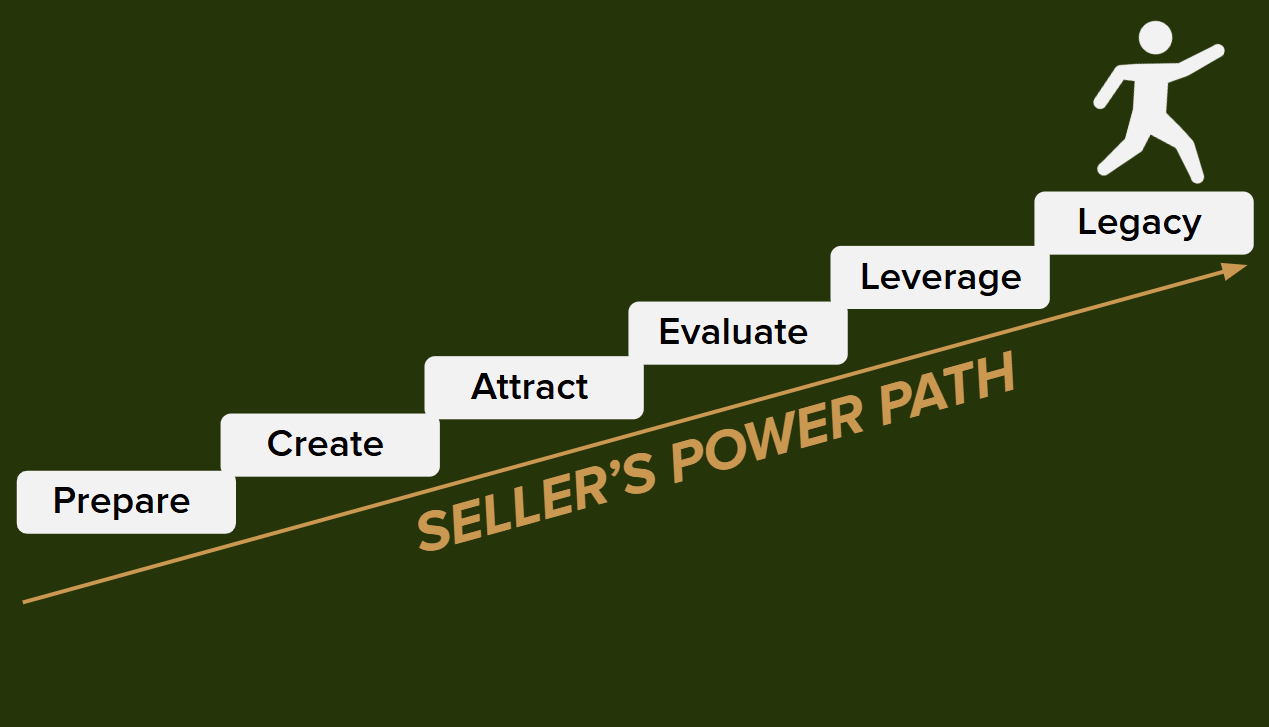

Only 20% of owners sell without regrets — they’re the ones who follow a narrow, proven path that protects negotiating power at every turn. The Seller’s Power Path is how you seize and maintain leverage and control — so you exit on your terms.
Each stage adds value and builds on the last — so you don’t just get a premium price, you protect your people, your name, your terms — everything that makes up your legacy.
1. Prepare
It starts with a forensic analysis. It can feel invasive — but it’s the rigor that makes the valuation bulletproof. Your elite M&A team digs into every building block of the asset: systems, cash flow drivers, customer mix, operational strengths, and more. They surface hidden value drivers and risk flags. Then your team tailors every component of the playbook to your objectives.
Leverage Gained:
You start with a bulletproof valuation and strategy no buyer can poke holes in.
2. Create
Buyers build their own story if you don’t shape it first. This stage uses your Forensic Analysis to identify the unicorn buyers who stand to gain the most — the ones who’ll see the bright future your company unlocks. That insight shapes the must-own narratives tailored for each buyer type. Your team draws on real intelligence — earnings calls, annual reports, shareholder letters — to craft these stories through the buyer’s future-focused lens, not your rear view.
Leverage Gained:
You anchor buyers to credible future upside — not just your history.
3. Attract
Top buyers don’t chase generic deals. A Buyer Intelligence Lead curates a tight list of buyers who have the most to gain — the ones who see your company as indispensable in their larger strategy or as the enabler of their transformational vision. Controlled outreach, backed by real intelligence — earnings calls, annual reports, company websites, press releases — lets buyers see the bright future they unlock by buying your business. This isn’t about manufactured urgency — it’s about undeniable strategic fit.
Leverage Gained:
Scarcity and credible competition force buyers to show up strong.
4. Evaluate
Not every offer is what it seems. Your team stress-tests each one: the structure, the buyer’s financial capacity, and their reputation. What’s their history of closing on time? Retrading after the LOI? Negotiating fairly when you’re most exposed? Your team also protects you from inappropriate liability buried in reps, warranties, or indemnities. And they break down the risks tied to payout structures — like credit risk, management risk, or LP risk in earnouts, seller financing, or equity rolls. A headline price means nothing if it vanishes when it’s time to fund what matters next.
Leverage Gained:
You choose your deal — you don’t settle for it.
5. Leverage
When multiple credible buyers compete, your Transition Architect leads the negotiation — not the buyer. They hold the line on structure, pace, and terms. Every play so far compounds here: scarcity, trust, and positioning collide to give you command when it matters most.
Leverage Gained:
You seize and maintain leverage and control all the way to close.
6. Legacy
You spent decades building reliable revenue and a resilient culture — intentionally and systematically. The same mindset builds leverage for a peak outcome sale. The right exit fuels your family for generations and unlocks the wealth to realize your philanthropic vision. You sell without regrets because you refused shortcuts — and because you built leverage the same way you built everything else that lasts.
Leverage Gained:
You keep what matters most — your family’s future, your impact, and your legacy.
Bringing It All Together
Most owners wish they’d protected negotiating power like they protected their customers or culture. The 20% who sell without regrets know leverage is built intentionally — stage by stage — just like revenue and trust. The Seller’s Power Path shows you how to seize and maintain leverage and control through every stage — so you exit on your terms, protect your people, and secure the price and structure that all serve your legacy.
Previous:
Up Next:
Seller’s Path to Regrets
A cautionary roadmap: the shortcuts and missteps that drain value from a sale. Understand each stage—so you can recognize the signs early and avoid...
Deal Structures
Understand your deal’s building blocks — earnouts, equity rolls, seller financing, and more. These cards break down how structures work, when they’re used...
94% of owners who try to sell their business have regrets.1 Whether they fail to find a qualified buyer or leave money on the table, the vast majority of business owners wish they could have done things differently. The 6% who transition without regrets don’t get there by accident. They follow an intentional course.
The Seller’s Power Path is our transition framework to maximize leverage and control for business owners. After realizing first-hand that the historical approaches were not serving middle market owners, we borrowed tactics utilized in multi-billion-dollar sales, right-sized them for the middle market, and refined them over 44 completed business sales.
The Seller’s Power Path’s 95% company sell rate and 88% sold above the valuation flow from its six stages:

Stage 1: PREPARE
A. Clarify Objectives for Cash Out, Employees, Real Estate, and Timing
First, we define and prioritize concrete objectives for the sale process. Your top priorities determine how we prioritize buyers, how we position your company, how we build the forecasts, and how we negotiate with buyers.
In one recent medical-device sale we’ll call “RegenMD," the owners prioritized maximal cash at close and minimal ongoing involvement and liability.
Without priorities, sellers react instead of lead. As Zig Ziglar said, “If you aim at nothing, you hit it every time.”
B. Forensic Analysis
Yes, this step can feel invasive because outcomes depend on precision. However, by examining your company with rigor, our team can create a bulletproof valuation and identify buyers who pay more because they enjoy greater ROI. We dig into every building block of the company and industry structure. We surface value drivers and opportunities that could supercharge your sale and risks that could torpedo it.
We always adjust financials to highlight larger normalized EBITDA by removing non-market, non-recurring and discretionary expenses. This is part of enabling buyers to see the business through their lens.
In RegenMD’s case, the seller had already completed a third-party valuation. Rather than redo it, our team built on the analysis. For example, we expanded on the recasting of the financials. One of RegenMD’s owners was receiving $400,000 annually despite barely working after a stroke. In the recast financials, that expense was normalized to market levels, adding over $300,000 in additional EBITDA. Similar adjustments were made for the unhelpful marketing expenses. Buyers weren’t asked to “take it on faith.” We showed our (math) work. Since the forensic analysis work was done upfront, buyer diligence later took weeks, not quarters.
In the broader market, approximately half the letters of intent are not consummated in a closed transaction. Most failed or regretted exits are not due to a lack of buyers, but due to poor preparation, weak positioning, and loss of leverage during the process. The most common reasons are avoidable through upfront forensic analysis.
The last part of the forensic analysis is assessing whether the business and M&A environment can deliver the seller's desired outcomes.
C. Low-Hanging Fruit and Skeletons
We provide a list of force-ranked improvements that can increase business value, mostly without significant time or resource investments.
In preparation for RegenMD’s sale, we saw several opportunities to increase barriers to entry and decrease risk for prospective buyers, including extending contract terms, making agreements transferable, and tightening employee non-solicitation language. We also persuaded the owners to rapidly cut spending with an underperforming vendor. As this vendor spend decreased, sales rose, providing empirical evidence to buyers that future profitability would be higher than the company’s history.
D. Right People on the M&A Bus
Next we assemble a team of skilled professionals tailored for your specific situation. This includes the “core team” on our payroll, and auxiliary members such as M&A attorneys and accountants, and the business owner’s wealth and charitable advisor.
RegenMD had a generalist accountant they trusted for annual tax work. However, selling this company benefitted from a different level of expertise here and elsewhere. Our team recommended a nimble M&A legal firm, an accounting specialist, and a web (traffic and metrics) analyst.
Stage 2: CREATE
If you don’t shape your own story, then buyers will write their own. The “Create” stage leverages the strategic, financial, operational, and technical building blocks from the Forensic Analysis to identify the unicorn buyer types who stand to gain the most from your business: the ones who’ll see the brightest futures your company unlocks. Different buyers produce different outcomes from the same business. One of your most important decisions is to create the conditions for the right buyers to compete for your company. Your company’s strengths are selected and positioned to form must-own narratives tailored for each buyer type. Our M&A team draws on real intelligence such as earnings calls, annual reports, and shareholder letters, to craft these stories through the buyer’s future-focused lens, not your rear-view mirror. As a result, we anchor buyers to a credible and compelling future upside instead of your company’s history.
In RegenMD’s sale, the team identified strategic buyers as the highest-value acquirers because their existing sales forces can deliver the highest profit growth with RegenMD’s high gross margins. A detailed forecast showed how those buyers could deploy their current sales reps and marketing infrastructure to dramatically accelerate revenue growth. RegenMD was also relevant for many other buyer types, so our potential outreach list grew to over 10,000. The RegenMD narratives we created for each buyer type weren’t hypothetical. They were grounded in the buyers’ own realities and aspirations.
Stage 3: ATTRACT
After we identify the buyers who see your company as indispensable in their larger strategy or as the enabler of their transformational vision, our personalized outreach begins. This controlled outreach, backed by real intelligence enables buyers to see the bright future they unlock by purchasing your business. This step is not about manufactured urgency. It’s about showcasing an undeniable strategic fit. Resonance and scarcity galvanize buyers to lean in aggressively.
In RegenMD’s case, each email highlighted the specific value drivers and synergies that were relevant to each strategic, private-equity, and search-fund buyer. Each customized email explained in under 50 words why this business mattered to them.
Stage 4: EVALUATE
Not every offer is what it seems. Our M&A team stress-tests each one: the structure, the buyer’s financial capacity, and their reputation. What’s their history of closing on time? Retrading after the LOI? Are they willing to pursue win-win, or do they insist on exposing you to undue risk? How do buyers treat their current employees?
Our M&A team also protects you from inappropriate liability buried in reps, warranties, or indemnities. We break down and mitigate the risks that derail most deals and outcomes such as retrading, financing that falls through, and earnouts that never materialize. A headline price means nothing if much of it vanishes when it’s time to fund what matters next. Therefore, we put just as much emphasis on risk-adjusted outcomes associated with different deal structures, certainties, and buyer qualities. With all of this clarity, you choose your terms instead of settling for them.
In RegenMD’s transaction, 25 offers ranged from 50% to 160% of the upfront valuation. Some looked attractive on paper but relied on uncertain future payments or external financing. The final selection prioritized the seller’s defined objectives, not just the headline price.
Stage 5: LEVERAGE
Our team doesn’t let the buyer lead the negotiation. By securing many credible buyers to compete for your business, your Transition Architect possesses leverage to orchestrate the negotiation. They hold the line on structure, pace, and terms. Every preceding play compounds here: scarcity, trust, and positioning collide to give you command when it matters most. Smart sellers seize and maintain leverage all the way to the closing table.
Since some buyers couldn’t imagine walking away from RegenMD, they agreed to a non-refundable deposit. This is one of many ways they prove their confidence in closing.
Non-refundable deposits protects sellers from wasted time and last-minute concessions. Pace, terms, and structure were set by the seller, not dictated by the buyer.
Stage 6: LEGACY
You spent decades intentionally and systematically building reliable profits and a resilient culture. That same mindset builds leverage for a peak sale outcome. The right exit fuels your family for generations and unlocks the wealth to realize your philanthropic vision. You sell without regrets because you refused shortcuts and because you built leverage the same way you built everything else that lasts.
What are “Legacy Outcomes?”
1) Not leaving money on the table
2) Finding a buyer who cares for your employees
3) Bolstering your family unity and direction
4) Investing more time and money into your favorite non-profits and mission-driven businesses
At the outset of the “Prepare” phase, RegenMD’s owners prioritized maximizing cash at close and minimal ongoing involvement and liability. They have the satisfaction of their closing price being 160% of the upfront valuation to an all-cash buyer, and only being on call to answer questions for two months.
They also have the fulfillment of knowing their product will serve millions of additional patients through a buyer with the scale to expand it responsibly. The owners exited without regrets.
Bringing It All Together
Bringing It All Together
Most owners wish they’d protected negotiating power like they protected their customers and culture. The 6% who sell without regrets know leverage is built with intention and stage by stage, just like revenue and trust. The Seller’s Power Path shows you how to seize and maintain leverage and control through every stage, so you exit on your terms, protect your people, and secure the price and structure that all serve your legacy.
TESTIMONIAL
“From the first conversation about my objectives to the moment the funds hit our bank account, Legacy Outcomes led with calm authority. We always knew exactly where we stood and what came next. They coordinated every moving part with discipline and foresight, steadily strengthening our leverage as the process advanced. When it was time to close, they delivered our priorities: maximum price, maximum cash at closing, and minimal post-sale involvement on a silver platter."
-Owner, RegenMD
Sources:
1Donald; “State of Owner Readiness - Exit Planning Institute”
Previous:
Up Next:
Seller’s Path to Regrets
A cautionary roadmap: the shortcuts and missteps that drain value from a sale. Understand each stage—so you can recognize the signs early and avoid...
Deal Structures
Understand your deal’s building blocks — earnouts, equity rolls, seller financing, and more. These cards break down how structures work, when they’re used...
Up Next:
Deal Structures
Understand your deal’s building blocks — earnouts, equity rolls, seller financing, and more. These cards break down how structures work, when they’re used...
Previous:
Seller’s Path to Regrets
A cautionary roadmap: the shortcuts and missteps that drain value from a sale. Understand each stage—so you can recognize the signs early and avoid...

Preserve your legacy by securing the best price, terms, and steward of your employees and company.
quick Links
© Copyright 2025, All Rights Reserved By Legacy Outcomes